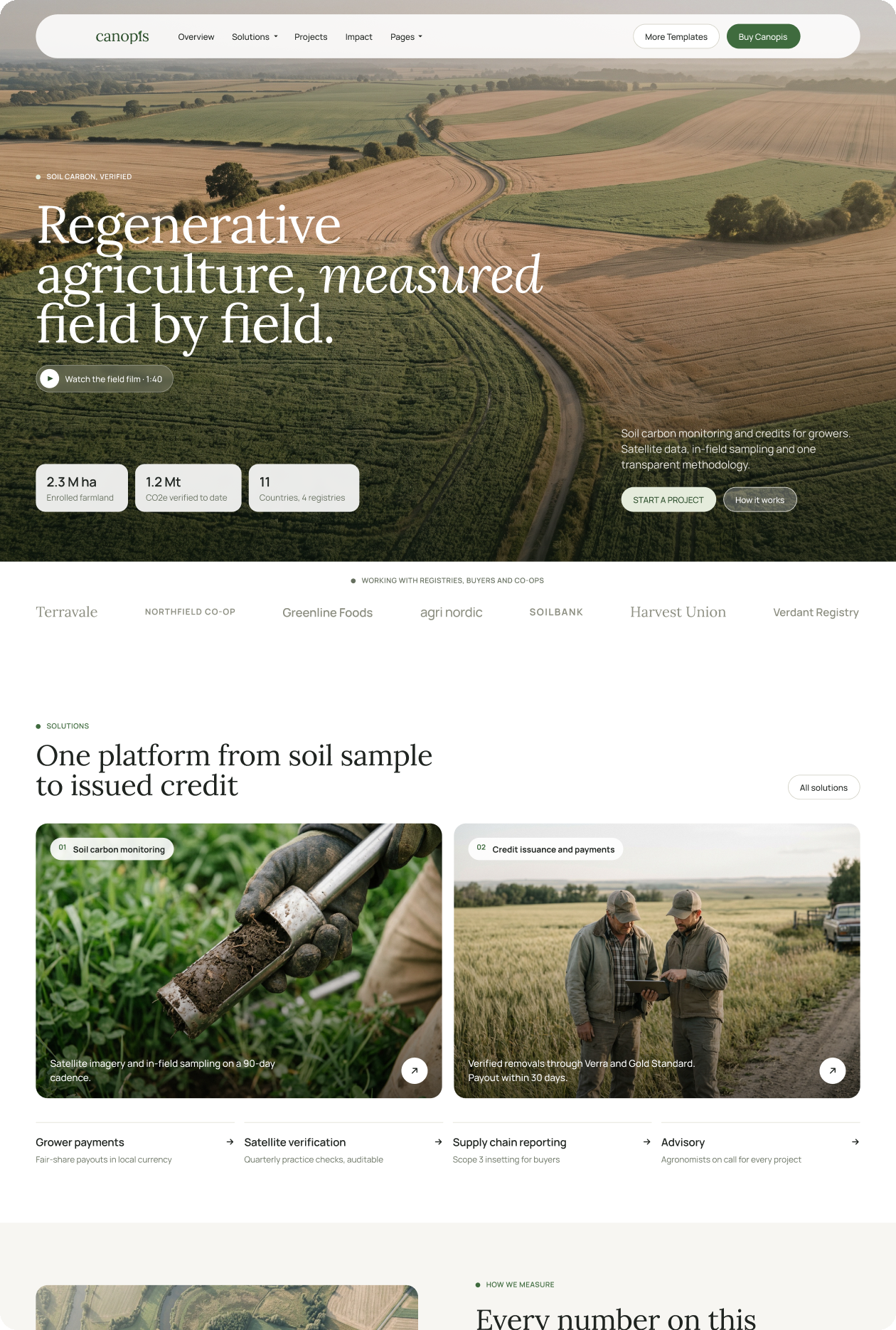
How to Build a Climate Tech Website That Buyers and Investors Trust

Climate tech buyers and investors have one question before they engage: can you prove it?
Generic promises no longer work. In 2026, buyers run due diligence before the first call, investors check methodology before a meeting, and procurement teams look for verified results before they register interest. Your website is where that evidence lives - or doesn't.
This guide walks through the pages and content a climate tech company needs to build genuine credibility online, and shows how the Canopis Webflow template gives you a structure to do it fast.
What do climate tech buyers actually check on your website?
Buyers check three things: whether your technology works, whether others have used it with real results, and whether your numbers are audited. They want a methodology page, project case studies with verified outcomes, and a clear path to speak to someone. If any of those are missing, they move on.
Does your website need a dedicated methodology page?
Yes. A methodology page is the single most important trust signal for a serious buyer or investor. It should explain how your technology works, what you measure, how you verify it, and what third parties audit the results. Without it, you are asking visitors to take your word for everything.
Canopis includes a Technology page built for exactly this. You can publish your process specs, your measurement approach, and your verification partners in a structured layout that is easy to read and easy for AI tools to extract.
How should you present impact data on a climate tech website?
Show results by region and by year. Do not combine everything into one headline number. Buyers and investors want to see how results change over time and whether they hold across different geographies. A single aggregate figure is easy to question. A table of verified outcomes by project and year is much harder to dismiss.
Canopis has an Impact page designed for this. You can show results broken down by region and year in a clean, scannable layout - no custom build needed.
What makes a project case study credible to a serious buyer?
Three things make a case study credible. First, it names the specific project and location. Second, it shows verified results - not estimated results. Third, it links to or includes a downloadable audit pack so the buyer can check the methodology themselves. A case study without at least one of these is a story, not evidence.
The Canopis Projects CMS is built for this. Each project entry supports verified results, a project story, and a downloadable audit pack. You can publish a library of case studies that double as due-diligence documents.
Does your website need a separate Solutions section?
Yes, if you serve more than one buyer type. A climate tech company often talks to corporate buyers, carbon credit registries, government procurement teams, and investors at the same time. Each group has different questions. A Solutions section lets you speak to each group's specific concerns without cluttering your homepage.
Canopis includes three Solutions pages. You can map one to each buyer segment and address their specific questions - technology fit, compliance, ROI, permanence - without sending everyone through the same generic homepage.
What role do green-claims rules play in your website copy in 2026?
Two sets of rules matter right now. In the EU, the Empowering Consumers for the Green Transition Directive became enforceable on 27 September 2026. It bans generic unsubstantiated environmental claims - words like "eco-friendly," "sustainable," or "green" used without specific proof - for any company selling to EU customers. In the US, the FTC's Green Guides (last updated 2012, currently under review) allow the FTC to act on deceptive environmental claims under Section 5.
This is not legal advice, and you should consult a compliance specialist for your specific situation. The practical implication for your website is straightforward: publish evidence for every claim you make. If you say your process removes carbon permanently, show the methodology and the audit. If you claim verified results, link to the verification. Proof protects you and it builds trust.
How do you turn website visitors into demo bookings?
Make the demo request the single clearest next step on your site. Do not hide it behind a contact form. Name what happens after the request - who they speak to, how long the call is, what they will learn. Buyers who have read your methodology and seen your impact data are already convinced. They need a frictionless way to act.
Canopis includes a dedicated Request a Demo page with a clean, focused form. You can set the page as your primary CTA target from every Solutions, Technology, and Impact page, and keep the path from research to conversation as short as possible.
What pages does a climate tech website need at launch?
At a minimum: Home, Technology (methodology), Impact (results by region and year), Solutions (one per buyer segment), Projects (verified case studies), About, and Request a Demo. You can add Insights (field notes and research updates) and Careers as the company grows. Anything less and you are asking serious buyers to trust claims you have not backed up.
Canopis covers all of this in 27 pages across home variants, solution pages, about variants, project and insight detail pages, and a focused demo-request page. The Figma source file is included with the $129 Webflow + Figma purchase.
In summary
- Climate tech buyers check methodology, verified results, and audit trails before they engage.
- A methodology page is your most important trust signal - publish your process, your metrics, and your verification partners.
- Show impact data by region and year, not as a single headline figure.
- Project case studies need verified results and a downloadable audit pack to carry weight.
- A Solutions section lets you address corporate buyers, registries, and investors separately.
- The EU's ECGT Directive (enforceable from September 2026) and FTC Green Guides both require you to back up every environmental claim.
- Your demo request page should be the clearest next step from every proof-heavy page on your site.
Frequently asked questions
How long should a climate tech website methodology page be?
Long enough to answer the four core questions: what you do, how you measure it, how you verify it, and who audits the results. In practice, 400 to 600 words plus a process diagram is enough for most buyers. The goal is specificity, not length.
Should a climate tech startup publish its pricing on its website?
It depends on your sales model. If you sell carbon credits at a published price, show it. If you price by project scope after a discovery call, you do not need a price page - but you should be transparent about how pricing works. Buyers who cannot find any pricing signals often assume the cost is out of reach.
What is an audit pack and why does it matter for climate tech websites?
An audit pack is a downloadable document that supports a project case study. It typically includes methodology details, measurement records, third-party verification, and registry links. Publishing one with each case study turns a story into evidence. It also reduces the number of questions in early buyer conversations.
How is a climate tech website different from a standard SaaS website?
The proof burden is higher. A SaaS site needs social proof and feature clarity. A climate tech site needs verified results, published methodology, and compliance-ready claims. Buyers are not just assessing fit - they are assessing scientific and regulatory credibility. The website structure needs to reflect that.
Build the proof, then build the site
Canopis gives you the structure to publish your methodology, impact data, and project proof from day one - without a custom build. The Technology, Impact, and Projects pages are ready to fill in, the demo path is built, and the Figma file is included so your brand team can customise every detail.
Want it live in five days? Our team customises Canopis with your branding, content, and integrations. See the customisation service.